
Venusian Wind Speeds and Atmospheric Dynamics
Comprehensive overview of wind patterns in Venus's atmosphere, from superrotating zonal jets to near-surface boundary layer flows, drawing on data from Akatsuki, Venus Express, and earlier missions.
Venusian Winds: A Superrotating Enigma
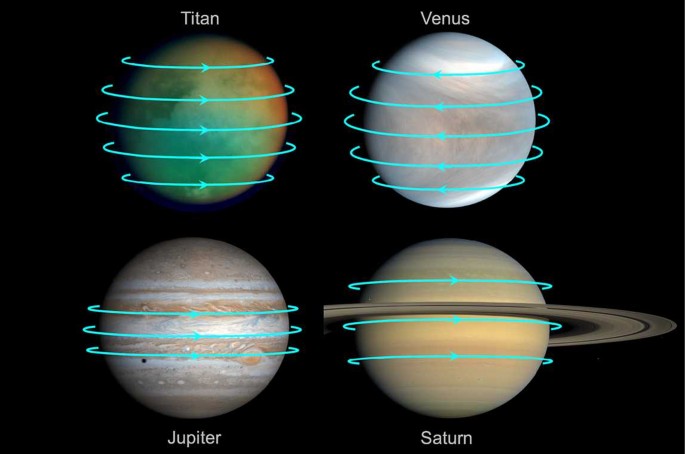
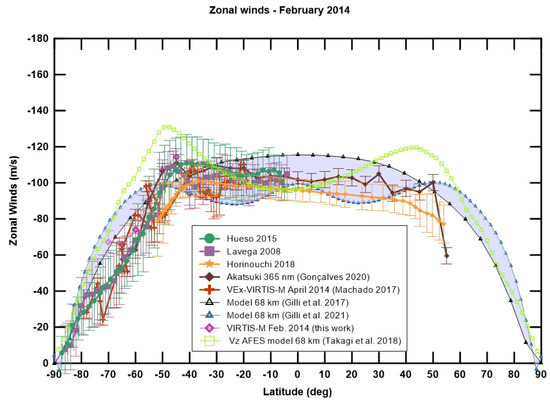
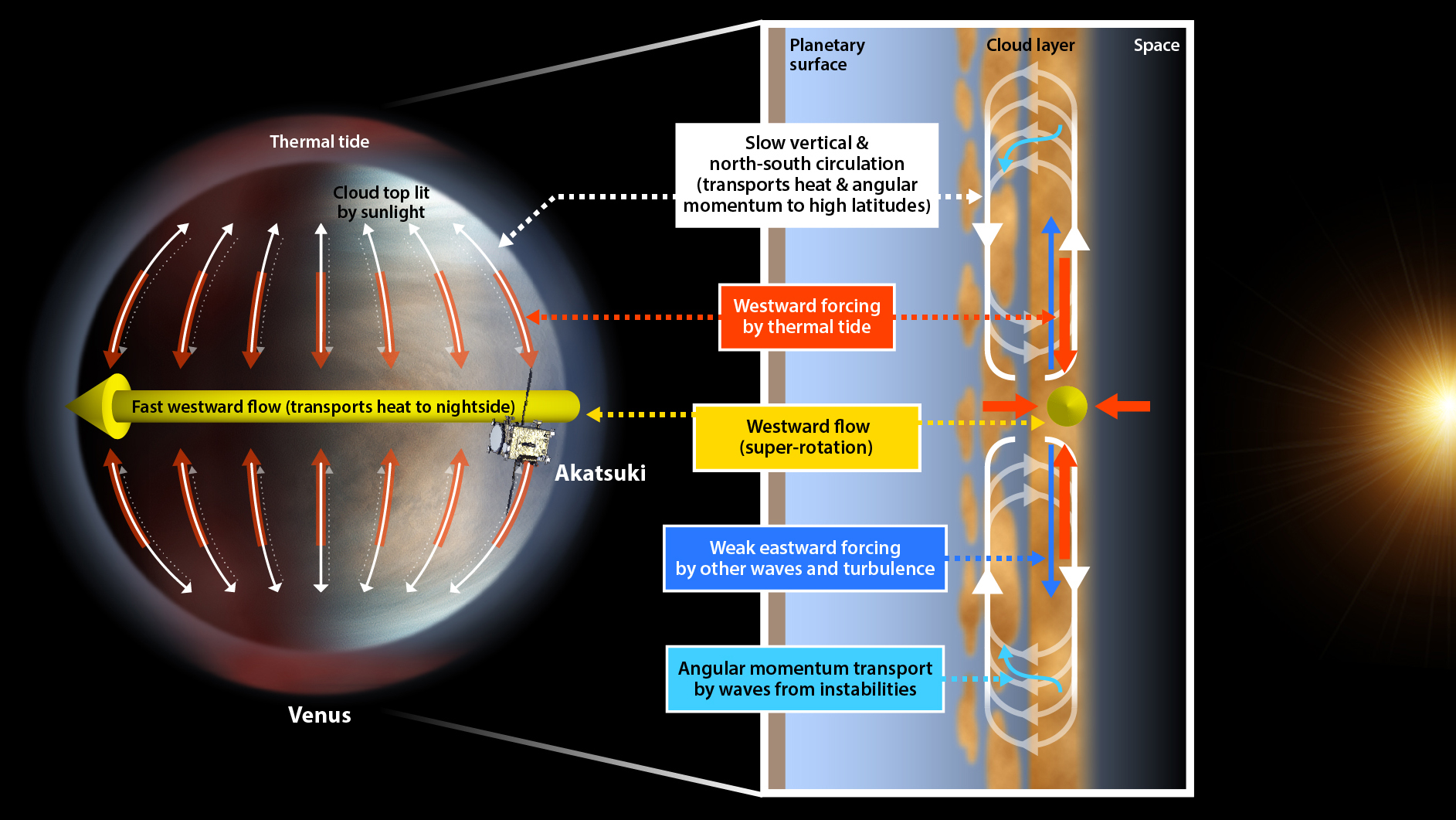
Venus’s atmosphere exhibits one of the solar system’s most extreme circulation patterns: superrotation, where the atmosphere rotates westward (retrograde) up to 60 times faster than the planet’s solid body. This results in zonal wind speeds peaking at ~100 m/s (360 km/h) at cloud-top altitudes (~65-70 km), while near-surface winds slow to ~1-2 m/s due to friction and dense air.
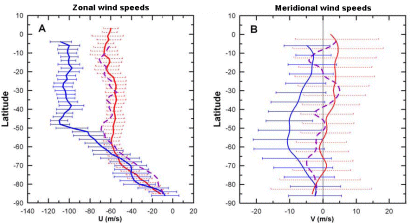
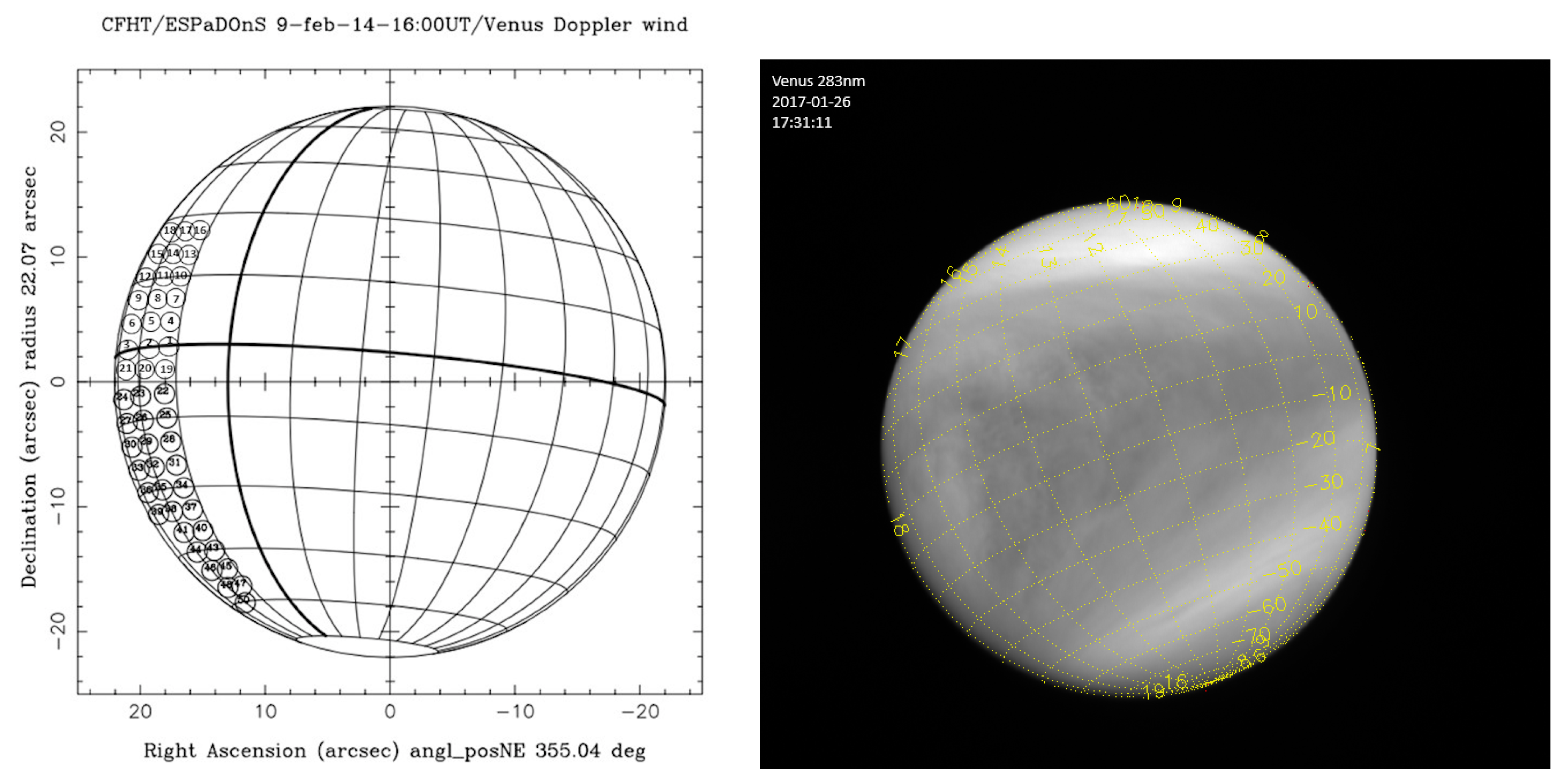
Data from missions like Japan’s Akatsuki (2015-2025) and ESA’s Venus Express (2006-2014) reveal wind speeds varying dramatically with altitude, latitude, and local solar time. Akatsuki’s infrared and ultraviolet imaging tracked cloud motions to map winds, confirming accelerations in some regions over time and revealing an equatorial jet in lower clouds.
“Venus has a thick atmosphere that rotates 60 times as fast as the surface, a phenomenon known as super-rotation.”
— Horinouchi et al. (2020)
Waves and turbulence transfer momentum upward from the surface and downward from higher altitudes, sustaining the jet-like flows. Recent studies highlight thermal tides as a key driver, with diurnal tides playing a primary role in momentum transport.
Wind Profiles by Altitude
Wind speeds increase rapidly from the surface to the cloud deck, peak at ~65-70 km, then decrease in the upper atmosphere, where deuterium enrichment takes place.
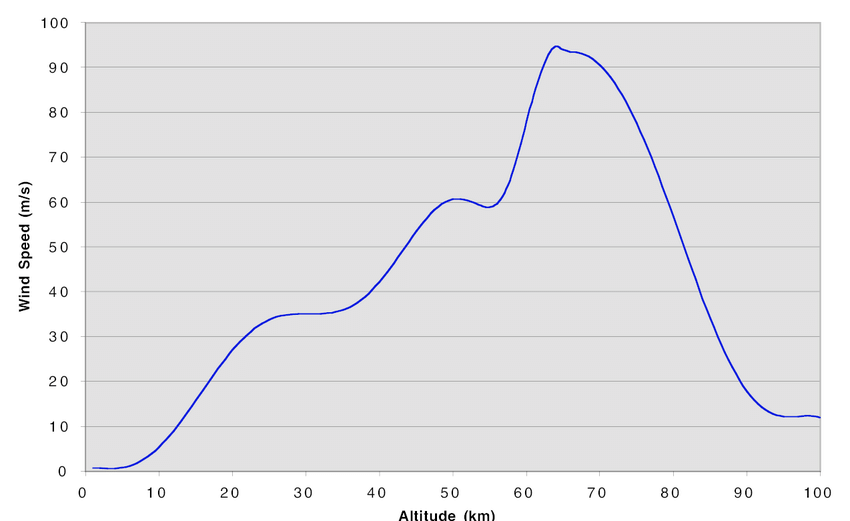
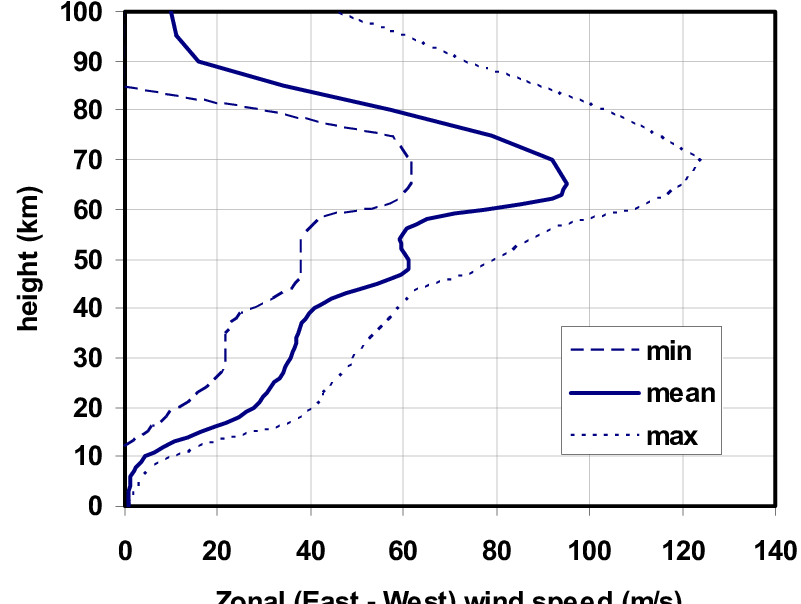
- Surface to 10 km (Boundary Layer): Zonal winds ~0.5-2 m/s, with meridional components <1 m/s. Slope winds over topography can reach 5-10 m/s locally.
- 10-50 km (Lower Clouds): Winds accelerate to 50-70 m/s zonally, with an equatorial jet in the lower-middle clouds.
- 50-70 km (Cloud Tops): Peak zonal superrotation at 90-110 m/s, often faster on the nightside (~360 km/h at 70 km).
- Above 70 km (Mesosphere): Winds remain strong (>100 m/s) up to 130 km, but variability increases with solar activity and tides.
Akatsuki’s Longwave Infrared Camera (LIR) measured zonal winds of 68-70 m/s at low latitudes, with visible images showing long-term variations. Venus Express noted accelerations, with average cloud-top winds rising over years.
Boundary Layer Dynamics
The planetary boundary layer (PBL) on Venus extends from the surface to ~10-20 km altitude, where surface friction, topography, and convection shape winds. Unlike Earth’s thin PBL, Venus’s is influenced by extreme surface pressure (92 bar) and temperature (737 K), leading to slow but turbulent flows.
- Eolian Transport: Near-surface winds, though low (~1 m/s average), can mobilize dust and sand via saltation, forming dunes observed by Magellan radar. Turbulent-resolving models suggest gusts enable erosion over highlands.
- Convective Vortices: Diurnal heating generates slope winds and convective cells, with potential for dust devils or vortices.
- Topographic Influence: Over features like Aphrodite Terra, upslope flows during “day” reach 5 m/s, contributing to gravity wave generation.
Simulations with the IPSL Venus Global Climate Model indicate PBL exchanges heat and momentum, affecting deeper structure. Slope winds drive local accelerations, with waves contributing to superrotation.
“The exchanges of heat and angular momentum drive the temperature and wind structure in the deepest layers of Venus’s atmosphere.”
— Lebonnois et al. (2018)
Venera landers measured variable high turbulence near the surface, with wind gusts potentially 2-3 times average speeds.
Turbulence and Gusts
Venus’s atmosphere is highly turbulent, especially in the cloud deck and boundary layer. Engineering models specify continuous gust profiles, with turbulent intensity ~0.02 at cloud levels.
- Cloud Deck Turbulence: Kelvin-Helmholtz instabilities from wind shear create eddies, with gusts ±10-20 m/s around mean flows.
- Boundary Layer Gusts: Near-surface, turbulence from convection and terrain can produce gusts up to 5-10 m/s, sufficient for eolian activity.
- Upper Atmosphere: Solar wind interactions induce turbulence.
Akatsuki data revealed planetary-scale waves and turbulence at cloud tops, with wind variations linked to instabilities.
Example Code Snippet from Wind Model
function getGustSpeed(alt: number, time: number): number {
	// Simple pseudo-random turbulence
	// Higher turbulence in cloud deck
	const intensity = (alt > 45000 && alt < 65000) ? 5.0 : 0.5;

	// Use time to drive phase
	const noise = Math.sin(time * 1000) + Math.sin(time * 314) + Math.sin(time * 10);
	return noise * intensity;
}
Early models simulate gusts via deterministic sine waves for turbulence, adding variability to base zonal/meridional speeds.
Implications for Atmospheric Dynamics and Missions
These winds challenge models of uniform circulation, with tides and waves decelerating or accelerating superrotation. Long-term variations show ~12.5-year cycles in cloud-top winds over Aphrodite Terra.
For missions, cloud-level winds enable “gravity wave surfing” over highlands, but turbulence demands robust aerodynamics.
ISRU Potential: Collecting Volcanic Ejecta from the Boundary Layer
Venus shows ongoing volcanism, with Magellan reanalysis and Akatsuki hints indicating active lava flows and eruptions.
- Ejecta Composition: Basaltic ash rich in silicates, metals, and volatiles (SO2, CO2).
- Boundary Layer Collection: Buoyant platforms or landers could harvest settled ejecta for ISRU, processing into propellants or materials. Turbulent mixing disperses particles, enabling sampling.
- Climate Impacts: Eruptions inject material into the PBL, potentially altering wind patterns via radiative feedbacks.
Future missions (VERITAS, EnVision) will map active sites.
Source Data:
- Akatsuki LIR and UVI cloud-tracking winds
- Venus Express atmospheric profiles
- Venera lander anemometer measurements
- Global Climate Model simulations (IPSL, LMD)
- Magellan radar for topography and eolian features
Referenced URLs
- https://www.science.org/doi/10.1126/science.aaz4439
- https://www.isas.jaxa.jp/en/topics/002372.html
- https://www.sciencedirect.com/science/article/abs/pii/S0019103517308497
- https://eos.org/research-spotlights/key-driver-of-extreme-winds-on-venus-identified
- https://www.jpl.nasa.gov/news/nasas-magellan-data-reveals-volcanic-activity-on-venus/
- https://www.researchgate.net/figure/Average-wind-speed-versus-altitude-within-the-Venus-atmosphere_fig3_24381363
- https://sci.esa.int/web/venus-express/-/43424-wind-speeds-in-venus-s-cloud-layers
- https://www.mdpi.com/2073-4433/12/4/506
- https://www.space.com/venus-atmosphere-super-rotation-mystery-solved.html